



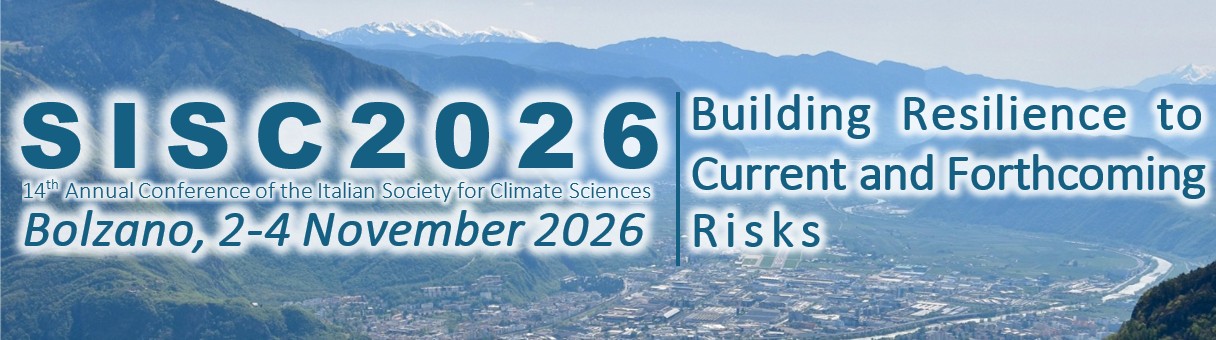
SISC2026 Call for abstracts
The Conference brings together leading scientists, researchers, economists, practitioners, business leaders, and policy makers working on different aspects of climate change, its impacts, and related responses. It provides a unique inter-transdisciplinary platform to share new research findings, exchange knowledge,and discuss practical solutions to one of the most pressing challenges of our time.
In the context of rapidly intensifying climate risks, this year the Conference aims to address interconnected climate challenges and strengthen societal resilience, focusing on understanding the dynamics of the climate system, assessing impacts and vulnerabilities across natural and socio-economic systems, and exploring strategies to strengthen resilience and support climate transitions. Particular attention will be given to integrating scientific knowledge with governance, innovation, and societal transformation, in order to support effective and equitable responses to climate change.
The Call for abstracts is now open!
We invite you to submit the abstract of papers on the following topics by:
29th May 2026 June 6th, 2026
Submit your abstract here.
If you and colleagues from your network have three to four abstracts connected by a common sub-topic related to the Conference topics, you are invited to propose a Thematic Session by:
29th May 2026 June 6th, 2026
See the Call for Thematic sessions here.
Abstract submission
The abstract must be between 4,000 and 8,000 characters long (including spaces) should be submitted online in English, no later than June 6th, 2026.
A maximum of three figures and bibliographical references may be included, which will not count towards the character count.
Use the template available Use the template available here.
Abstracts that do not meet these criteria will not be considered. Authors are requested to indicate their preferred presentation format when submitting their abstract (oral presentation or poster).
Topics
Topics of interest for submission include:
Topic1: Climate System and Extremes: Understanding a Changing Earth
Description: This topic focuses on advancing understanding of how the climate system is evolving across temporal and spatial scales, including extreme events, atmospheric processes, and Earth system feedback. This track aims to receive contribution from a wide range of spatial scales, from local to global, with a special attention to mountain climate and its connection to downstream regions. It invites contributions investigating past and future trends, climate change dynamics, governing mechanisms and shifts in Earth System components.
Potential sub-topics (list not exhaustive)
• Climate trends in means and extremes (observations, simulations, projections)
• Regional and global climate dynamics across scales
• Weather and climate extremes, including mountain systems
• Cryosphere changes: glaciers, snow, ice sheets and sea ice
• Earth system feedback and tipping points (including abrupt and irreversible changes)
• Predicting the evolution of the Earth system
• High-resolution modelling and downscaling approaches
• Improving land-surface and Earth system models for extreme events
• Downstream implications of climate variability and extremes
• Physical indicators and early warning signals for emerging climate risks
• Developing decision-relevant climate information from models and observations
Topic 2: Impacts, Risk and Adaptation Across Systems: From Knowledge to Resilience
Description: This topic addresses climate change impacts at the interface between natural and socio-ecological systems (SES) and how societies can respond effectively. We welcome contributions that explore multiple levels of complexity from sector-specific analyses to cross-sectoral, systemic approaches and landscape-based approaches. Submissions may address a range of spatial scales, from local to regional contexts, including urban, coastal, and mountain areas. Particular attention is given to water systems, urban environments, ecosystems, and vulnerable regions where climate risks are most evident.
Potential sub-topics (list not exhaustive)
• Climate impacts on natural, human and socio-ecological systems across landscapes
• Mountain and high-altitude regions as climate risk hotspots
• Water-related impacts, hydrological extremes and upstream–downstream dynamics
• Urban, coastal and mountain risk assessment and management
• Climate risk and disaster risk integration (qualitative and quantitative methods)
• Cascading and compound climate risks
• One Health, biodiversity and ecosystem resilience
• Adaptation pathways: robust, flexible and transformative approaches
• Climate services, decision-support tools and their uptake in planning and risk management
• Integrating climate risk into public budgeting, infrastructure planning and adaptation investment strategies
• Mainstreaming climate adaptation into planning tool
• Strategies of mountain communities.
• Barriers, limits and enabling conditions for effective adaptation implementation
Topic 3: Governance, Justice and Societal Transformation: Enabling Fair and Effective Climate Action
Description: This topic explores how governance systems, economic structures and societal dynamics shape both climate vulnerability and response. It welcomes contributions addressing the political, institutional and equity dimensions of climate change, and examining how institutions, communities and economic actors can enable inclusive, legitimate and durable climate action. Particular attention is given to participatory approaches, co-production of knowledge and transformative processes that align climate resilience with social justice.
Potential sub-topics (list not exhaustive)
• Climate justice, climate rights and equity dimensions and climate rights
• Distributional impacts of climate risks and the political economy of transition and adaptation (who bears risks, who pays, who benefits)
• The political economy of climate risk, adaptation finance and just transition
• Risk governance
• Risk perception, adaptive behaviour, eco-anxiety and societal transformation pathways
• Climate policy design, implementation and evaluation
• Economic and financial dimensions of climate transition (private finance, transition risks)
• Natural resource conflicts and climate-related conflicts (including water)
• Education, science communication, disinformation and public engagement
• Risk perception, adaptive behaviour and community resilience
• Transformative adaptation and transformative pathways
• Stakeholder engagement, participation and co-production of knowledge
• Local knowledge for societal transformation
• Participation, Transdisciplinary and Co-creation of knowledge
Topic 4: Sustainable Innovation in Mitigation and Climate Transition: Accelerating the Low-Carbon Future
Description: This topic focuses on the technological, digital and financial innovations driving mitigation and adaptation and the transition to climate-neutral systems. It addresses energy system transformation, decarbonization strategies, artificial intelligence, big data, and high-performance computing as enablers of ambitious climate targets.
Potential sub-topics (list not exhaustive)
• Mitigation technologies for ambitious climate targets
• Energy systems transition and decarbonization pathways
• Climate–energy nexus and system integration
• Emerging technologies for sustainable climate transition
• Data-driven tools for mitigation planning and monitoring
• AI, big data and high-performance computing for climate solutions
• Policy instruments, climate finance and mitigation–adaptation synergies: aligning innovation with private investment and just transition goals